Free tool
Bee or wasp? Identify it in 3 questions
The right fix depends on what it is. Honey bees can often be saved by a beekeeper; yellow jackets need pest control; ground bees and mud daubers often need nothing at all.
What are you seeing?
The quick guide
| Insect | Looks | Nest | Next step |
|---|---|---|---|
| Honey bee | Fuzzy, golden-brown | Wax comb; swarms hang in clusters | Swarm or hive? |
| Carpenter bee | Big, shiny black abdomen | Round holes in wood, sawdust below | Carpenter bees |
| Ground bee | Small, often dark, fuzzy | Many little holes with soil mounds | Ground bees |
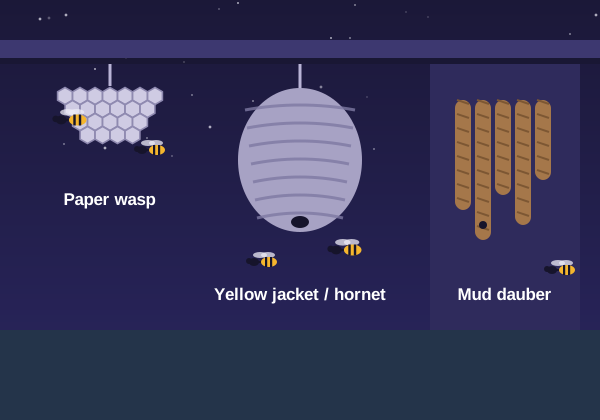
| Yellow jacket | Shiny, bright yellow and black | Hidden paper nest in ground or walls | Yellow jackets |
| Paper wasp | Long, slim, legs dangle in flight | Open paper comb under eaves | Paper wasps |
| Mud dauber | Very thin waist, black-yellow or blue-black | Mud tubes or lumps | Mud daubers |
Sources
Free quote
Tell us what you're seeing. We'll send it to one local bee removal company or beekeeper, and they'll reach out, often the same day. No cost, no obligation.
✓ 1 local company, not 5 · ✓ Free · ✓ No obligation
Common questions
How can I tell a bee from a wasp?
Bees are usually fuzzy and build wax comb. Wasps are smooth and shiny, with a narrow waist, and build nests from paper or mud.
Which ones are dangerous?
Yellow jackets, hornets and defensive honey bee colonies are the main risks. Ground bees, carpenter bees and mud daubers rarely sting.
Can you remove wasps too?
Yes. We pass wasp nest requests to one local company that handles wasps, usually a pest control company.