Houston, Texas
Bee removal in Houston, TX
Bees in your yard, wall or roof in Houston? Here's how to tell a swarm from a hive, what Texas rules mean for you, and how to get one local pro to call.
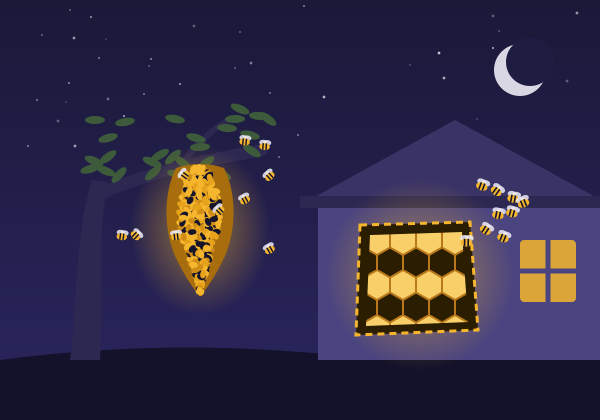
Bee season in Houston
With a long warm season, colonies stay active for much of the year. Swarms are most common in spring, but they can show up in other months.
Humidity and heavy rain can push bees into wall voids and attics. Bees flying in and out of the same gap for days are almost always building comb inside.
Where bees move in around Houston homes
- walls and soffits
- attics and eaves
- water meter boxes
- hollow trees and stumps
- sheds and outbuildings
Bees flying in and out of the same gap for more than a day or two are building comb inside. That's a hive, and it won't leave on its own. Not sure? Take the 30-second swarm-or-hive check.
Texas rules that apply in Houston
- Removers register with TAIS. Beekeepers who do removals must be registered with the Texas Apiary Inspection Service, and can choose to be listed on its bee removal page.
- No "bee removal license." TAIS notes there is no state license or certification for bee removal. Ask about experience, insurance and references.
- Chemicals need a pest control license. A beekeeper without a pest control license can't use chemicals during a removal. For extermination, you need a licensed pest control company.
- Africanized bees were first found in the US near Hidalgo, Texas, in 1990 and are common in much of the state.
More detail: bee removal in Texas.
Local contacts
Texas A&M AgriLife Extension, Harris County
Your county extension office answers questions about bees, wasps and other insects around the home, and can help identify what you're seeing. It doesn't remove bees.
What bee removal costs in Houston
Prices in Houston follow national ranges: swarms often $0 to $200, hives about $150 to $650 when they're easy to reach, and cut-outs from walls and roofs about $200 to $1,500 or more, with repairs often extra. Height, how long the bees have been there and how defensive they are all move the price. Try the cost calculator or read what bee removal costs. Swarms are sometimes free from a beekeeper.
How it works
- Tell us what you see and where, in Houston or nearby.
- We send it to one local bee removal company or beekeeper that serves your area. Never a list.
- They reach out with a price. You decide. Sending a request is free.
We take requests across Houston and nearby areas, including Katy, Sugar Land, The Woodlands, Pearland, Pasadena and Cypress.
Wasps instead of bees? See wasp nest removal.
Rules change. We list what the official sources below said when we checked on 2026-11-22; confirm current rules with the agency.
Other Texas cities
Sources
Free quote in Houston
Tell us what you're seeing. We'll send it to one local bee removal company or beekeeper, and they'll reach out, often the same day. No cost, no obligation.
✓ 1 local company, not 5 · ✓ Free · ✓ No obligation
Common questions
How much does bee removal cost in Houston?
Most Houston jobs fall in national ranges: swarms $0 to $200, easy-to-reach hives $150 to $650, and wall or roof cut-outs $200 to $1,500 or more, plus repairs. See the cost calculator.
Are the bees in Houston Africanized?
Africanized honey bees are established in Texas, and you can't tell them apart by looking. Treat every wild colony with caution and leave removal to a professional. See Africanized bees.
Is there free bee removal in Houston?
Sometimes. Many beekeepers collect swarms hanging in the open for little or nothing. Bees living inside a wall, roof or meter box are a paid job. See free bee removal.
Do you cover Katy and Sugar Land?
Yes. We take requests across Houston and nearby areas, including Katy, Sugar Land, The Woodlands, Pearland, Pasadena and Cypress. We pass each one to a single company or beekeeper that serves that area, or tell you if we don't have one there yet.
Can the bees be removed alive?
Often, especially swarms. Choose "Save the bees if possible" on the form. The company will tell you whether live removal makes sense for your colony.